
The story
Why these kimono are chosen one by one — and by whom.
The name
KAHORI comes from two words. Kaho (香), my given name: not the scent you put on, but the one that rises — what a person gives off without having to show it. Ori (織): weaving, cloth, the gesture passed from one hand to the next.
Together, kahori says what I want to do: to dress you in cloth woven in Japan, and to let an air form around you that belongs to no one else. A kimono does not cover you — worn, it lets your own scent rise, the one no one else can wear.
That is what I look for in a garment. Not what it shows, but what it leaves behind.
Who I am
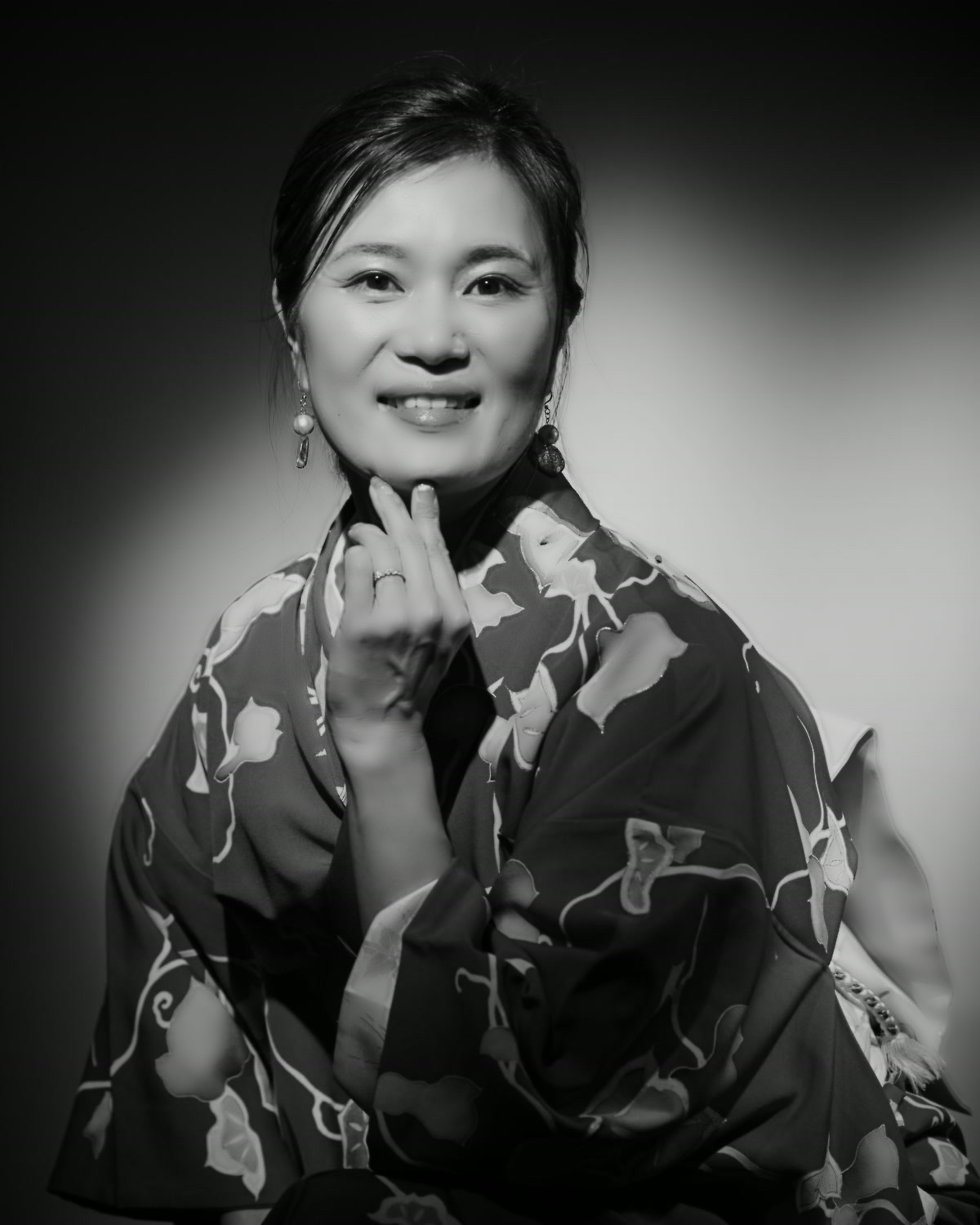
I am Japanese, born in Osaka, living in France.
I trained first as a nurse, in cardiac surgery and stroke care. Then as a qualified teacher of Japanese, in Australia first and in France afterwards. I am today the European representative of a Japanese organisation devoted to reihō, the Japanese art of gesture and protocol.
Those trades look unrelated. Yet a single phrase holds them together: to set right. The body, the breath, the habit, the bearing. A kimono belongs to that — you do not hold yourself the same way when you are wearing one.
What I believe
This is not fast fashion. This is not simply a dress. It is an encounter.
A vintage kimono carries the stories and the gestures of Japanese artisans. It was worn, folded and kept — sometimes across two generations — before it came this far. Given a second life in France, between your hands and your skin, it becomes alive again: silent, but alive, because it is you who gives it breath.
Upcycling is not a way of spending less. It is an art — when it meets your silhouette, your scent, your way of being.
How I work
- Chosen one by one. Every piece is bought individually in Japan. Once it is gone, we will not have another of it.
- Checked by hand, measured to the centimetre. The measurements shown are those of the very piece you will receive, not those of a size chart.
- Marks are shown. Where a piece carries a stain or a trace of yellowing, it is photographed and described, never hidden. That is the mark of time, and it is exactly what separates an old garment from a new one.
- Shipped from France. No customs to pay, no waiting several weeks.
- Reworked when it is needed. When a piece speaks to you without quite fitting, it can be altered: that is where made to measure begins.
The garment is a door
Behind the kimono there is tea, gesture, the way a cloth is folded, the language. I pass those on as well, in workshops and in lessons — see the experiences.
And if you are hesitating over a piece, write to me. I answer myself: contact.